

In short
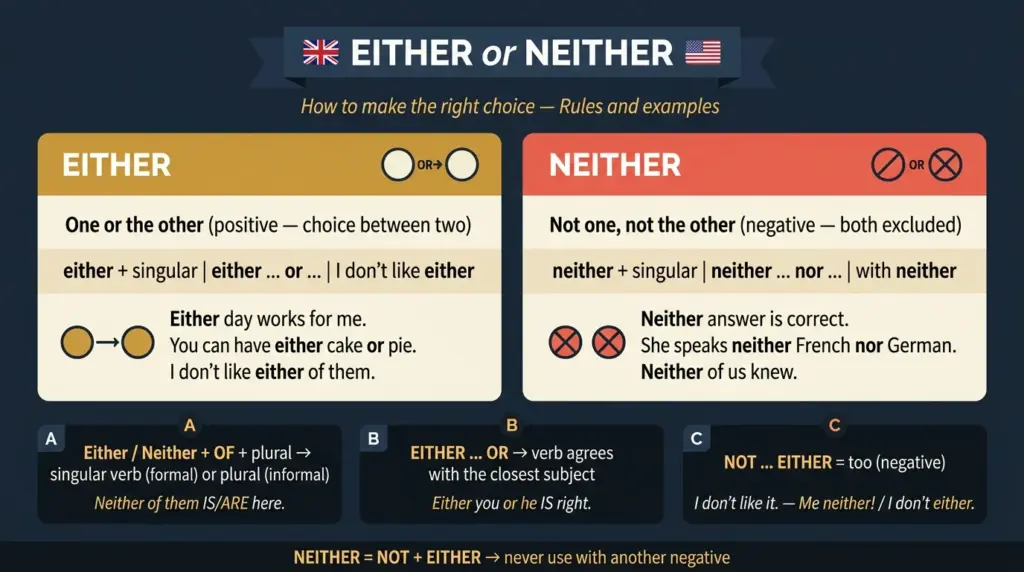
- Either… or: used in affirmative sentences to express two choices.
- Neither… nor: used in negative sentences when both choices are excluded.
- Expressing agreement with a negative: Neither do I (short answer) or I don’t either (verb is already negative).
- Agreement rule: Neither on its own always takes a singular verb.
- 4 functions: Either and neither can act as adverbs, determiners, pronouns, and conjunctions.
Either and neither are two very common words in English, but understanding the rules of either vs neither often confuses many learners. They work in pairs: either… or for possible choices, and neither… nor when both options are excluded. To express agreement with a negative statement, both can be used depending on the sentence structure.
Either… or: making a choice
The either… or structure is used in affirmative sentences. It presents two possible choices or expresses a conditional consequence: if one option is not chosen, the other one applies.
| Example | Meaning |
|---|---|
| I can serve you either a beer or a glass of wine. | You have the choice between a beer and a glass of wine. |
| Either you tidy your room, or I’ll turn off the WiFi. | One action will result in the other. |
| I will either go jogging or to the gym. | I will do one of these two activities. |
| Either mum or dad will come to pick you up. | One of the two parents will come. |
| You can call me either at home or at the office. | Both locations are valid options to call. |
| If it rains, we’ll either go to the cinema or to a museum. | We will choose between these two indoor activities. |
The verb agrees with the closest subject when two subjects are connected by either… or:
| Example | Verb agreement |
|---|---|
| Either Paul or his friends are coming. | Agreement with his friends (plural, closest subject) |
| Either his friends or Paul is coming. | Agreement with Paul (singular, closest subject) |
Neither… nor: excluding both options
The neither… nor structure is used to exclude two options simultaneously. The verb remains in the affirmative form in English, as the negation is carried by neither and nor themselves.
| Example | Meaning |
|---|---|
| He speaks neither Spanish nor Italian. | He does not speak Spanish, and he does not speak Italian. |
| I like neither him nor his sister. | I do not like him, and I do not like his sister. |
| It’s neither Paul nor Mike who made the mistake. | Paul did not make the mistake, and Mike did not either. |
| I will neither call you nor send you a message before midnight. | I will not call, and I will not send a message. |
| The boy had neither the time nor the patience to help. | He lacked both time and patience. |
| Neither the blue one nor the red is available in size 4. | Both colors are unavailable in that size. |
The English verb is always in the affirmative form with neither… nor. Adding not would create a double negative, which is incorrect in standard English.
Expressing agreement with negative statements: either vs neither
To agree with a negative statement, two structures are possible depending on whether the sentence already contains a negative verb or not.
Case 1: short answer with inversion (Neither + auxiliary + subject)
| Initial statement | Short answer | Meaning |
|---|---|---|
| I don’t like horror films. | Neither do I. | I also do not like them. |
| She can’t swim. | Neither can I. | I also cannot swim. |
| We haven’t been to Japan. | Neither have we. | We also have not been there. |
| He didn’t come. | Neither did she. | She also did not come. |
The auxiliary verb always matches the one used in the original sentence.
Case 2: full sentence with an already negative verb, using either at the end
| Example | Meaning |
|---|---|
| I don’t like horror films either. | I also do not like horror films. |
| We haven’t been to New Zealand either. | We also have never been to New Zealand. |
| She doesn’t like spinach. No, I don’t like it either. | She dislikes spinach, and I dislike it too. |
When the sentence already contains a negative verb (don’t, can’t, haven’t…), either is used at the end of the sentence. Using neither would create a double negative.
| Structure | Example | Rule |
|---|---|---|
| Neither + auxiliary + subject | Neither do I. | Short answer, inversion required |
| Subject + negative verb + either | I don’t like it either. | Full sentence, verb is already negative |
| Me neither | Me neither. | Very informal register, spoken English only |
Either and neither as determiners
Before a singular noun, either and neither function as determiners. Either then means “each” or “both”. Neither means “not one or the other”.
| Example | Meaning | Sense |
|---|---|---|
| The house has a door at either end. | The house has a door at both ends. | Either = each side |
| There were flowers on either side of the path. | There were flowers on both sides of the path. | Either = both sides |
| Neither journalist could finish their article. | Not one of the two journalists could finish their article. | Neither = not one or the other |
| Neither Isabelle nor Regina is happy. | Isabelle is not happy, and Regina is not happy. | Neither = not one nor the other |
Keep in mind: neither as a determiner takes a singular verb, even when two people are mentioned.
Either and neither as pronouns (+ of)
When followed by of, either and neither become pronouns. They refer to one element among several already mentioned. The verb remains singular.
| Example | Meaning |
|---|---|
| Does either of these roads go to Rome? | Does one of these roads lead to Rome? |
| Do either of the boys have maths this afternoon? | Does one of the boys have a math class this afternoon? |
| Either of these bags is fine for me. | One or the other of these bags suits me. |
| Neither of my parents went to university. | Not one of my parents attended university. |
| Neither of my arms is strong enough to lift this suitcase. | Both of my arms are too weak to lift this suitcase. |
| I like neither of these two books. | I do not like either of these two books. |
Neither of is used exclusively for two elements. For three or more elements, none of is used instead.
| Situation | Correct form | Example |
|---|---|---|
| Two books | neither of | I like neither of his two books. |
| Three or more books | none of | I like none of his books. |
Either alone at the end of a sentence: “one or the other”
Either can be used alone, at the end of a sentence, to express indifference between two previously proposed options. It then means “one or the other” or “in either case”.
| Example | Meaning |
|---|---|
| Do you fancy an Italian or a French restaurant? I’d be happy with either. | Both options are perfectly fine for me. |
| Take whichever you like. Either is fine. | Both choices are acceptable. |
| You can leave today or tomorrow. Either works for me. | Both days are convenient for me. |
Idiomatic expressions with either and neither
| Expression | Meaning | Example |
|---|---|---|
| Either way | In any case | You can stay or go. Either way, I’ll be happy. |
| In neither case | In not one of the two cases | In neither case is the result acceptable. |
| That’s neither here nor there | It is irrelevant | Whether you agree or not is neither here nor there. |
| On either side | On both sides | People were standing on either side of the road. |
Summary: either vs neither
| Function | Either | Neither |
|---|---|---|
| Conjunction | either… or = one or the other (affirmative) | neither… nor = not one nor the other (negative) |
| Agreement with negative | I don’t like it either. | Neither do I. |
| Determiner | either side = each side | neither option = not one of the two options |
| Pronoun + of | either of them = one of them | neither of them = not one of them |
| Verb agreement | Singular | Singular |
| Number of elements | Always two | Always two (otherwise: none) |
Practice exercise
Test your knowledge on the use of either, or, neither, and nor in English:
Question 1: Fill in the blanks: “He speaks ___ Spanish ___ Italian.”
Question 2: “I don’t like horror films.” How do you reply with a short answer to agree?
Question 3: Which sentence correctly uses either… or to offer two choices?
Question 4: Which of these sentences is correct?
Question 5: What does either way mean?
Question 6: Fill in the blank: “She can’t drive. I can’t drive ___.”