

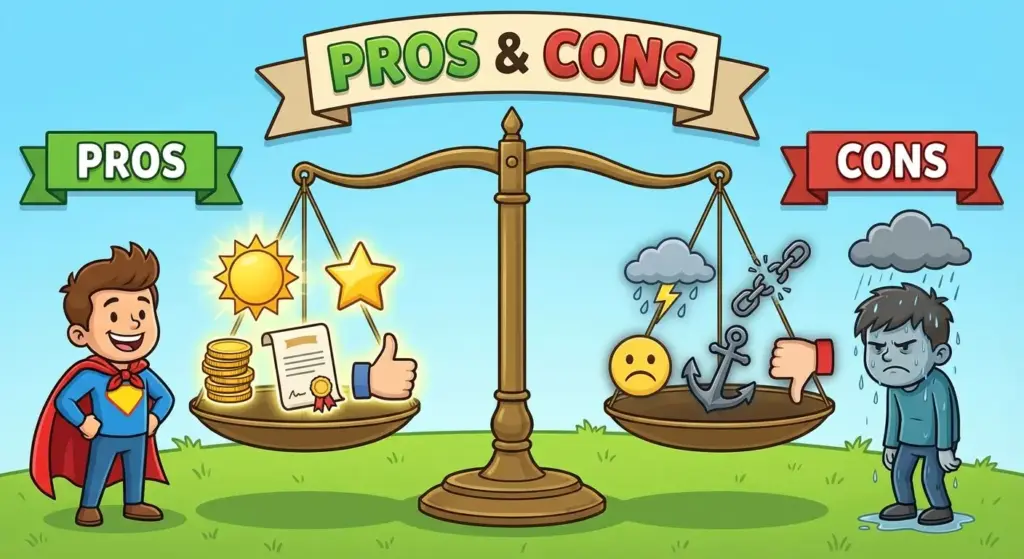
“The pros and cons” is one of the most commonly used expressions in English. It simply refers to the advantages and disadvantages of a given situation, decision, or topic.
Pros is short for arguments pro, from Latin, and refers to the positive aspects of something. Cons is short for arguments contra, also from Latin, and refers to the negative aspects.
When someone says they are “weighing the pros and cons,” it means they are carefully thinking through both sides before making a decision.
How to pronounce it
Pros is pronounced /prɒz/ and cons is pronounced /kɒnz/.
The phrase is always used together. It would sound very unnatural to say just “the pros” or “the cons” without the other.
How to use it in a sentence
Here are some natural examples, from everyday life to more formal situations.
Everyday life:
- “We need to think about the pros and cons before we move to a new city.”
- “There are pros and cons to working from home.”
Work and business:
- “The team weighed the pros and cons of the new marketing strategy.”
- “Before signing the contract, make sure you understand all the pros and cons.”
Health and medicine:
- “The pros and cons of this surgery need to be discussed carefully.”
- “Every treatment option comes with its own pros and cons.”
Finances:
- “We looked at the financial pros and cons of buying vs. renting.”
- “Investing in stocks has its pros and cons.”
Common mistakes to avoid
There are a few errors that come up frequently when using this expression. Always use the preposition to after “pros and cons,” never on. For example, “there are pros and cons to this decision” is correct, while “there are pros and cons on this decision” is not.
The word must always be in plural form. Saying “the pro and the con” is incorrect. The only exception is when referring to a single advantage or disadvantage on its own.
Another common mistake is forgetting the preposition about when using the expression with a verb like “think.” The correct form is “I’m thinking about the pros and cons,” not “I’m thinking the pros and cons.”
Similar expressions worth knowing
Several other expressions can be used in place of “the pros and cons,” depending on the context and the level of formality.
“Advantages and disadvantages” is more formal and works well in essays and reports. “Upsides and downsides” is casual and very common in spoken English. “Strengths and weaknesses” is often used when talking about people or organizations. “Trade-offs” is used when one benefit comes at the cost of another.
A real-life example: should you buy a car?
A practical way to understand this expression is to apply it to an everyday situation, like deciding whether to buy a car.
On one hand, owning a car brings freedom to go anywhere at any time, makes long trips more comfortable, and is useful for transporting groceries or luggage.
On the other hand, a car is expensive to maintain and insure, traffic and parking can be stressful, and it is not as environmentally friendly as public transport.
This is exactly the kind of situation where “weighing the pros and cons” comes in handy.
Key takeaway
“The pros and cons” is a versatile and essential expression in English. Once mastered, it can be used confidently in both casual conversations and professional settings. The key is simple: always consider both sides before making a decision. That is exactly what native English speakers do every day.