


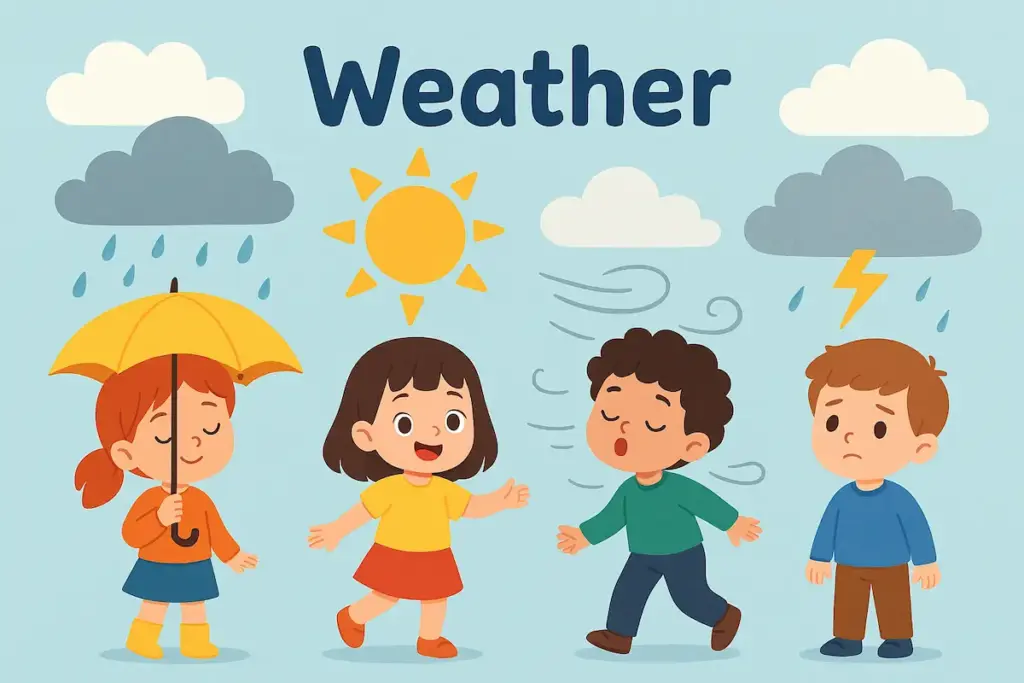
We often talk about the weather to break the ice with someone new. Knowing weather vocabulary in English is therefore a great way to approach someone you don’t know, especially when traveling abroad.
1. Basic Weather Vocabulary
Weather Phenomena
| Word | Definition | Example |
|---|---|---|
| Sun | The star that provides light and warmth to Earth | The sun is shining brightly. |
| Cloud | A visible mass of water droplets or ice crystals in the sky | The sky is full of clouds. |
| Rain | Water falling from clouds in drops | It’s raining cats and dogs. |
| Snow | Frozen water vapor that falls as white flakes | The snow is falling heavily. |
| Wind | Moving air, especially a natural current | The wind is blowing strongly. |
| Storm | Violent weather with strong winds and usually rain | There was a terrible storm. |
| Thunderstorm | A storm with thunder and lightning | A thunderstorm occurred last night. |
| Fog | Thick mist that makes it difficult to see | There is a thick fog outside. |
| Rainbow | An arc of colors in the sky after rain | A rainbow appeared after the rain. |
| Hail | Frozen rain that falls as hard balls of ice | It hailed yesterday afternoon. |
Temperatures and Conditions
| Word | Definition | Example |
|---|---|---|
| Hot | Having a high temperature | It’s hot today. |
| Cold | Having a low temperature | It’s cold outside. |
| Freezing | Extremely cold, at or below 0°C (32°F) | The temperature is freezing. |
| Warm | Pleasantly hot, comfortable temperature | It’s a warm day. |
| Humid | Having a lot of moisture in the air | It’s very humid. |
| Dry | Having little or no moisture | The air is dry. |
2. Describing the Weather
Asking About the Weather
How to ask about the weather:
- How’s the weather? = A casual way to ask about current conditions
- What’s the weather like today? = More specific question about today’s conditions
- Is it sunny/rainy/cloudy outside? = Asking about a specific weather condition
- What’s the temperature? = Asking about how hot or cold it is
Describing Weather with “It’s…”
Tip: To describe the weather in English, we often add the suffix -y to nouns. For example: cloud becomes cloudy.
- It’s sunny = The sun is shining
- It’s cloudy = There are clouds in the sky
- It’s rainy = Rain is falling
- It’s snowy = Snow is falling
- It’s windy = There is strong wind
- It’s foggy = There is fog
3. Idiomatic Expressions
- It’s raining cats and dogs. = It’s raining very heavily
- Break the ice. = Start a conversation or make people feel comfortable
- Be on cloud nine. = Be extremely happy
- I feel as right as rain. = I feel perfectly healthy and well
- I’m snowed under. = I’m overwhelmed with work or tasks
- A storm in a teacup. = Making a big deal out of something minor
- Every cloud has a silver lining. = There’s something positive in every bad situation
- Come rain or shine. = No matter what happens, in any circumstances
4. Practice Exercise
Test your knowledge with this quiz:
5. Conclusion
You now know the complete vocabulary for talking about the weather in English. Practice by describing the weather each day. The more you practice, the easier it will become.
Next time you meet an English speaker, you can start the conversation by asking: “How’s the weather today?”
Good luck and enjoy learning English! 🌈