


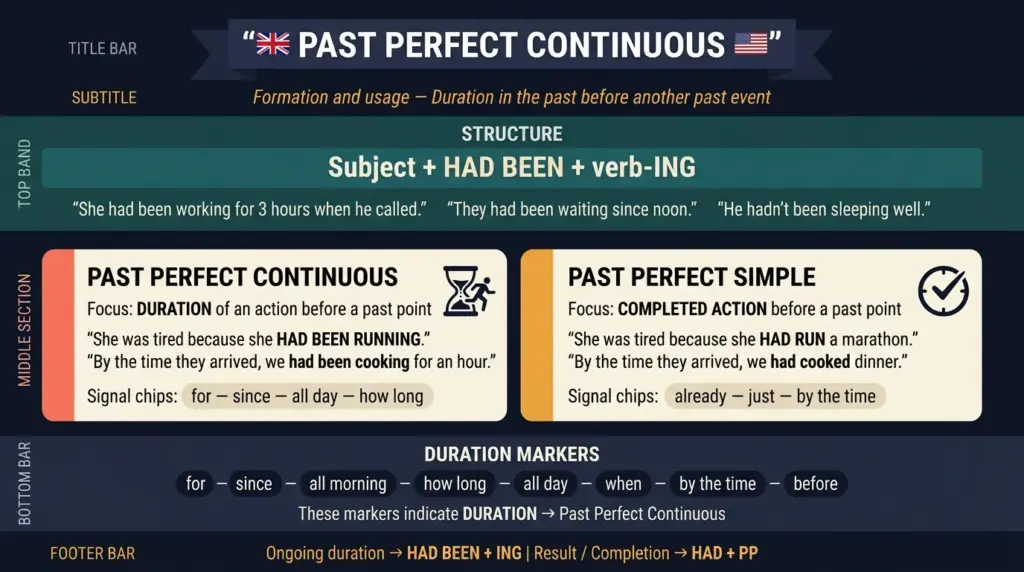
In short
- Long past action: expresses an action that lasted before another defined moment in the past.
- Fixed structure: always used with the subject, followed by had been and the verb ending in -ing.
- Duration value: highlights the time spent performing a specific activity.
- Visible cause: often explains a physical state or a result observed in the past.
Telling a story in the past sometimes requires organizing events in chronological order. The past perfect continuous tense serves precisely to describe a long action before another past event. This verb tense particularly emphasizes the duration of this action.
Forming the past perfect continuous tense
The construction of this verb tense remains very regular. It presents no major difficulty for ESL learners aiming for a B1 or B2 level. You simply need to combine three distinct elements. The first element is the auxiliary have conjugated in the simple past. This gives had for all persons. The second element is the past participle of the verb be. This is the invariable word been. The third element is the main verb of the action. You add the -ing ending to this verb.
The mathematical formula for this tense is simple to memorize. Here is how to remember it easily. Subject + had + been + verb with -ing.
In spoken English, native speakers very often contract the auxiliary. The word had becomes a simple apostrophe followed by a d. The expression I had been is then pronounced I’d been.
| Sentence form | Concrete example |
|---|---|
| Affirmative | They had been waiting. |
| Negative | She had not been sleeping. |
| Interrogative | Had he been working? |
The negative form uses the word not. This word is placed right after the auxiliary had. The contraction gives hadn’t. The expression had not been then becomes hadn’t been. This contracted form is mainly used in spoken language. Formal written texts, such as those required in IELTS or TOEFL exams, prefer the full form.
Expressing duration before a past action
This verb tense places an action before another past action. It strongly emphasizes the progress of the first action. The speaker wants to show that the activity took time. The second action often interrupts the first one. This second action is generally expressed in the simple past.
Here is a clear situation to illustrate this point. It had been raining for hours when we left. The departure represents the precise moment in the past. The rain represents the long action prior to this departure.
Specific words are often used to mark this duration. The word for indicates the total duration of the action. The word since indicates the starting point of this action. The expression how long is used to ask a question about the duration.
| Time marker | Example of use |
|---|---|
| For | He had been reading for two hours. |
| Since | They had been driving since morning. |
| All day | She had been studying all day. |
Explaining a result in the past
Another frequent use concerns the consequences of an action. The past perfect continuous tense explains why something happened. The long action is finished at the past moment mentioned. But its effects or results remain very visible.
Let us take an everyday example. Paul was tired because he had been running. Fatigue is the state observed in the past. Running is the long action that explains this fatigue.
Attention is focused on the process. The duration or intensity of the action justifies the final result. It is a cause-and-effect relationship in the past. The simple past describes the result. The past perfect continuous gives the cause.
Comparison with the past perfect simple
Choosing between the simple form and the continuous form sometimes poses a problem. Both tenses express an action prior to a past moment. However, their meaning differs slightly. The past perfect simple focuses on the completion of the action. It highlights the accomplished result. The past perfect continuous focuses on the activity itself.
Let us compare two very similar sentences. The first is: I had painted the room. This means that the room was completely painted. The work was finished. The second is: I had been painting the room. This indicates that the painting activity occupied the time. The room was not necessarily finished.
The past perfect simple often answers the question how much or how many. It counts the number of things achieved. The past perfect continuous answers the question how long. It measures the elapsed duration.
| Past perfect simple | Past perfect continuous |
|---|---|
| Emphasizes the final result. | Emphasizes the process and the action. |
| Indicates a completely finished action. | Indicates a sometimes unfinished action. |
| Expresses precise quantities. | Expresses a duration or a period. |
The special case of stative verbs
The -ing form has an important limitation in English. Certain verbs completely reject this ending. They are called stative verbs. They describe a fixed situation and not a dynamic action. Feelings, thoughts, or possession fall into this category.
Verbs like know, like, want, or believe never use the continuous form. When faced with such a verb, the rule changes. You must use the past perfect simple. The simple tense is used even to emphasize duration.
You never say: They had been knowing each other for years. This sentence is incorrect. The correct version requires the simple form. You will therefore say: They had known each other for years. The verb know imposes this structural modification.
The verb have requires special attention. If it expresses possession, it is a stative verb. It is then used in the simple tense. If it expresses an action, you can use the -ing form. For example, the expression have lunch clearly designates an ongoing action.
Nuances with the past continuous
The past continuous simply describes an ongoing action in the past. The past perfect continuous tense adds an extra notion. It shows that the action had started well before another reference point. The past continuous observes the action at a precise moment. The other tense observes the duration elapsed up to that moment.
Let us observe the difference in meaning. When I arrived, he was reading. He was reading at the precise moment of arrival. When I arrived, he had been reading for two hours. The focus is on the two hours elapsed before the arrival.
Adding a precise duration often changes the choice of tense. The simple word for or since naturally pushes towards the perfect form. Without these duration indicators, the past continuous is more than enough to describe the scene.
The interrogative form and its specificities
Asking a question with this tense follows the classic inversion rules. The auxiliary had goes before the subject. The rest of the verb structure does not move. The word order is strict. First comes the question word if there is one. Then comes the auxiliary, the subject, been, and the verb ending in -ing.
The classic question about duration starts with how long. Here is a common model. How long had you been waiting when the bus arrived? This structure is used to ask the exact duration of a past wait.
Short answers only repeat the first auxiliary. You do not repeat the whole sentence. To the question Had they been working?, you answer with Yes, they had or No, they hadn’t. The word been completely disappears from affirmative or negative short answers.
Practical exercise
Test your knowledge on the formation and use of this past verb tense:
Question 1: What is the correct structure of the past perfect continuous tense?
Question 2: Complete the sentence: “She was exhausted because she _____ all day.”
Question 3: How do you ask a question about the duration elapsed in the past?
Question 4: Why is the sentence “I had been knowing him for years” incorrect?
Question 5: What is the correct negative form?
Question 6: Which word often indicates the starting point of a continuous action in the past?
Your score