


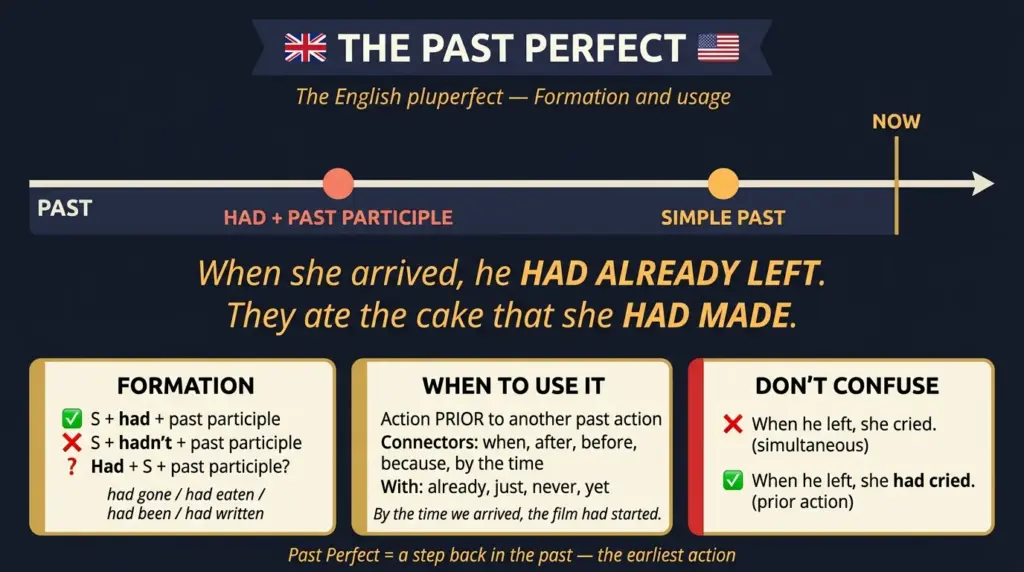
In short
- The main role: To express a past action that happened before another past action on a timeline.
- The basic formula: Subject + auxiliary verb had + past participle of the verb.
- The time association: The past perfect tense is almost always used with the past simple.
- Common indicators: Words like already, before, or after often accompany this tense.
In English, recounting multiple events in the past requires establishing a clear chronological order. The past perfect tense simply steps in to designate the oldest action on the timeline. This time mechanism prevents any confusion about the exact sequence of events.
The concept of the past perfect tense
The past perfect tense is essential for placing one event before another completed event on a timeline. It is often referred to as the past of the past. Without this tense, a sequence of facts in a story loses its chronological logic.
Imagine two completed actions. The first chronological action takes the past perfect tense. The second chronological action takes the past simple. The word order in the sentence does not matter. Only the anteriority of the action on the timeline dictates the use of the past perfect tense.
Concrete example: The train had already left when the travelers arrived at the station. The departure of the train precedes the arrival of the travelers. The departure is therefore expressed in the past perfect tense.
Formation in the affirmative form
The construction of this tense remains invariable. The auxiliary verb never changes according to the subject. You simply combine the auxiliary verb had with the past participle of the main verb.
The exact structure follows this model: Subject + auxiliary verb had + past participle. The past participle of regular verbs ends in -ed. Irregular verbs have their own forms to memorize.
| Full form | Contracted form |
|---|---|
| I had worked | I’d worked |
| You had worked | You’d worked |
| He/She/It had worked | He’d/She’d/It’d worked |
| We had worked | We’d worked |
| They had worked | They’d worked |
The contraction with the apostrophe followed by a d is very often used in spoken English. This abbreviated form makes pronunciation flow better. You must be careful not to confuse it with the contraction of would.
Examples of affirmative sentences:
The movie had started before the guests arrived. (The film had started before the guests arrived.)
She had lived in London for ten years. (She had lived in London for ten years.)
Formation in the negative form
The negation is built simply by adding the word not right after the auxiliary verb had. The past participle remains unchanged. This structure expresses an action that had not taken place before a reference point on the timeline.
The exact structure is: Subject + had not + past participle.
| Full form | Contracted form |
|---|---|
| I had not eaten | I hadn’t eaten |
| You had not eaten | You hadn’t eaten |
| He/She/It had not eaten | He/She/It hadn’t eaten |
| We had not eaten | We hadn’t eaten |
| They had not eaten | They hadn’t eaten |
The contracted form hadn’t appears in almost all everyday conversations. The full form had not applies mostly in formal or academic texts.
Examples of negative sentences:
They hadn’t finished their homework when the teacher entered. (They had not finished their homework when the teacher entered.)
It hadn’t rained for months. (It had not rained for months.)
Formation in the interrogative form
Asking a question with the past perfect tense requires a simple inversion. The auxiliary verb had moves in front of the subject. The main verb in the past participle keeps its position after the subject.
The formula looks like this: Had + Subject + past participle + rest of the sentence?
| Question | Short affirmative answer |
|---|---|
| Had I seen ? | Yes, I had. |
| Had you seen ? | Yes, you had. |
| Had he seen ? | Yes, he had. |
| Had we seen ? | Yes, we had. |
| Had they seen ? | Yes, they had. |
Interrogative words like where, when, or why are placed at the very beginning of the question. They precede the auxiliary verb had.
Examples of interrogative sentences:
Had she booked the tickets before Monday ? (Had she booked the tickets before Monday?)
Where had he worked before this job ? (Where had he worked before this job?)
Associated time markers
Certain adverbs very frequently accompany the past perfect tense. They reinforce the idea of anteriority on the timeline. They clarify the link between the two past events.
The word already emphasizes that an action was completed well before the second event. It is placed between the auxiliary verb had and the past participle.
The office was empty because everyone had already left. (The office was empty because everyone had already left.)
The word just indicates that an action had very recently occurred. Its position is identical to already.
She had just woken up when the phone rang. (She had just woken up when the phone rang.)
The word never expresses a total lack of experience up to that specific moment in the past.
I had never seen snow before my trip to Canada. (I had never seen snow before my trip to Canada.)
Association with before, after, and by the time
These conjunctions articulate the chronology of events on the timeline. They often dictate the use of the past perfect tense in a clause.
With after, the action that follows is the oldest. It takes the past perfect tense.
After they had eaten, they went for a walk. (After they had eaten, they went for a walk.)
With before, the action that follows is the most recent. It takes the past simple. The other action takes the past perfect tense.
He had locked the door before he went to bed. (He had locked the door before he went to bed.)
The expression by the time works similarly to before. It introduces the most recent action.
By the time the police arrived, the thief had escaped. (By the time the police arrived, the thief had escaped.)
The past perfect tense in reported speech
Reported speech relays someone’s words. When the reporting verb is in the past, the tenses of the reported words shift back one step. This phenomenon is called backshifting.
The past simple becomes a past perfect tense in reported speech. This rule maintains the chronological logic of the initial narrative.
Direct speech: John said: “I lost my keys.” (John said: “I lost my keys.”)
Reported speech: John said that he had lost his keys. (John said that he had lost his keys.)
The present perfect also transforms into the past perfect tense when shifting to reported speech.
Direct speech: Mary said: “I have finished my project.”
Reported speech: Mary said that she had finished her project.
The past perfect tense in conditional sentences
The third conditional expresses a regret about a past event. It describes an unreal situation that did not happen. The past perfect tense occupies a central place in this structure.
The clause introduced by “if” obligatorily uses the past perfect tense. The main clause uses the structure would have followed by the past participle.
If I had known, I would have come. (If I had known, I would have come.)
If she had studied harder, she would have passed the exam. (If she had studied harder, she would have passed the exam.)
The inversion of the subject and the auxiliary verb had can replace the word “if” in a very formal register. The meaning remains strictly identical.
Had I known, I would have come. (Had I known, I would have come.)
The continuous form of the past perfect tense
A variant of this tense focuses on the duration of an action. The past perfect continuous insists on the progression of an older action before another past action on the timeline.
The formation combines the auxiliary verb had, the past participle been, and the verb ending in -ing.
He had been waiting for two hours when the bus finally arrived. (He had been waiting for two hours when the bus finally arrived.)
The choice between the simple form and the continuous form depends on the message. The simple form focuses on the completed result. The continuous form highlights the duration of the activity.
Practical exercise
Test your knowledge by choosing the correct verb form:
Question 1: Complete the sentence: When I arrived at the station, the train ___.
Question 2: Complete the sentence: She ___ to London before 2015.
Question 3: What is the correct contracted form of “They had not seen”?
Question 4: Complete this conditional sentence: If you ___ me, I would have helped you.
Question 5: How do you ask the question “Had he eaten before the movie?”
Question 6: Complete in reported speech: He said that he ___ his homework.
Your score