


Summary
- Definition: Words used to point out specific nouns based on proximity.
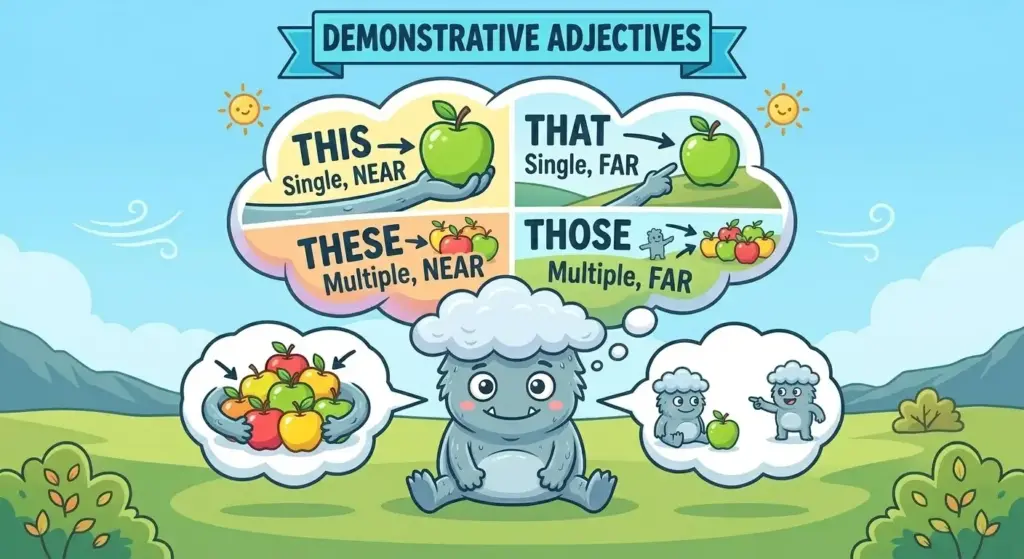
- Forms: There are four main forms: This, That, These, Those.
- Variables: Choice depends on distance (near/far) and number (singular/plural).
- Position: Always placed directly before the noun they modify.
- Distinction: Unlike pronouns, demonstrative adjectives cannot stand alone.
Definition and Function of Demonstrative Adjectives
A demonstrative adjective, often called a demonstrative determiner, is a word used to modify a noun so that the listener knows exactly which specific object, person, or concept is being mentioned. The term “demonstrative” comes from the Latin word *demonstrare*, meaning “to show” or “to point out.” In English grammar, these adjectives answer the question: “Which one?” or “Which ones?”. Without them, speech would remain vague. For instance, saying “I want the book” implies a specific book, but saying “I want this book” involves a figurative or literal pointing gesture, removing all ambiguity. The usage of these adjectives relies on two main grammatical criteria: 1. Number: Whether the noun is singular or plural. 2. Proximity: Whether the noun is physically or temporally close to the speaker.The Four Forms of Demonstrative Adjectives
English simplifies the complex gender systems found in languages like French or Spanish. There is no gender distinction (masculine/feminine) in English demonstratives. However, the distinction between singular/plural and near/far is rigid. The following table outlines the four forms based on these variables:| Near (Close to speaker) | Far (Away from speaker) | |
|---|---|---|
| Singular | This | That |
| Plural | These | Those |
1. “This” (Singular, Near)
This is used to modify a singular countable noun or an uncountable noun that is physically close to the speaker or currently present in time. * Example: This tea is too hot. (Ce thé est trop chaud.) * Context: The cup is likely in the speaker’s hand or on the table directly in front of them.2. “That” (Singular, Far)
That modifies a singular countable noun or an uncountable noun that is at a distance from the speaker. * Example: Look at that bird in the sky. (Regarde cet oiseau dans le ciel.) * Context: The bird is far away; the speaker might be pointing at it.3. “These” (Plural, Near)
These is the plural counterpart of “this.” It modifies plural nouns that are close to the speaker. * Example: These shoes are killing my feet. (Ces chaussures me font mal aux pieds.) * Context: The speaker is currently wearing the shoes.4. “Those” (Plural, Far)
Those is the plural counterpart of “that.” It modifies plural nouns that are distant from the speaker. * Example: Those mountains are magnificent. (Ces montagnes sont magnifiques.) * Context: The mountains are on the horizon, not within touching distance.Understanding Proximity: Space and Time
The concept of “proximity” in English grammar extends beyond simple physical distance. It encompasses spatial distance, temporal distance (time), and psychological distance.Spatial Proximity (Physical Distance)
This is the most literal usage. If an object can be touched, “this” or “these” is generally used. If pointing is required because the object is out of reach, “that” or “those” is appropriate. * Can you pass me that bottle? (Peux-tu me passer cette bouteille ?) — The bottle is closer to the listener than the speaker. * I love this dress I am wearing. (J’adore cette robe que je porte.) — The object is on the speaker.Temporal Proximity (Time)
Demonstrative adjectives are strictly used to locate events in time. * This / These: Used for the present or the immediate future/past. * That / Those: Used for the past or a distant future.| Time Frame | English Example | French Translation |
|---|---|---|
| Present / Near | I am busy this week. | Je suis occupé cette semaine. |
| Past / Distant | I remember that day well. | Je me souviens bien de ce jour-là. |
| Present / Near | These days are difficult. | Ces jours-ci sont difficiles. |
| Past / Distant | In those days, no one had cars. | À cette époque-là, personne n’avait de voiture. |
Psychological and Emotional Distance
Speakers often use “that” or “those” to create emotional distance or to express a negative attitude, even if the object is physically close. Conversely, “this” can imply acceptance or interest. * Get that cat off the sofa! (Fais descendre ce chat du canapé !) — Use of “that” indicates annoyance, even if the cat is nearby. * I love this idea! (J’adore cette idée !) — Indicates enthusiasm and closeness to the concept.Syntactic Placement and Agreement
Correct placement is crucial for maintaining grammatical accuracy. A demonstrative adjective must always precede the noun it modifies and any other adjectives describing that noun. Structure: Demonstrative Adjective + (Optional Descriptive Adjectives) + Noun * This old house. (Correct) * Old this house. (Incorrect)Agreement Rules
Unlike in French, where the adjective must agree in gender, English requires agreement only in number. A common error involves mixing singular demonstratives with plural nouns or vice versa. * Correct: This type of problem. * Incorrect: These type of problems. (Here, “type” is singular, so “this” must be used, even if “problems” is plural). * Correct: Those kinds of books. * Incorrect: That kinds of books.Distinction Between Demonstrative Adjectives and Pronouns
A frequent point of confusion arises because the words this, that, these, and those function as both adjectives and pronouns. The distinction lies in their syntactic function within the sentence.Demonstrative Adjective
The adjective cannot function alone. It acts as a determiner and must be followed by a noun. * This chair is broken. * “This” modifies “chair”. * Translation: Cette chaise est cassée.Demonstrative Pronoun
The pronoun stands alone. It replaces the noun entirely. * This is broken. * “This” acts as the subject of the sentence. * Translation: Ceci est cassé / C’est cassé. To determine if the word is an adjective or a pronoun, check the word immediately following it. If it is a noun, it is an adjective. If it is a verb (usually “is” or “are”) or stands alone at the end of a sentence, it is a pronoun. * I like that. (Pronoun – Direct Object) * I like that color. (Adjective – Modifies “color”)Specific Usage in Introductions and Communication
Demonstrative adjectives and pronouns have specific social functions in English, particularly during introductions on the phone or in person.On the Telephone
When identifying oneself on the phone, English speakers use “this” (never “I am”). When asking about the other person, they use “that”. * Hello, this is John speaking. (Allô, c’est John à l’appareil.) * Is that Mary? (Est-ce Mary ?)In Person Introductions
When introducing people to one another, “this” is used. * Lucy, this is my brother, Mark. (Lucy, je te présente mon frère, Mark.)Comparison for French Speakers
For learners whose first language is French, the challenge often lies in the automatic distinction of distance. In French, the demonstrative *ce/cet/cette/ces* is often used without specifying distance unless *-ci* or *-là* is added. In English, the choice between *this* and *that* is mandatory and cannot be omitted. * French: “Regarde ce livre.” (Could mean the one here or the one there). * English: One must choose between “Look at this book” (here) or “Look at that book” (there). Ambiguity is less tolerated in English regarding spatial positioning. If a speaker uses the wrong demonstrative, it can confuse the listener regarding the location of the item.Summary of Key Differences
| Feature | Demonstrative Adjective | Demonstrative Pronoun |
|---|---|---|
| Role | Modifies a noun | Replaces a noun |
| Structure | Followed by a noun | Followed by a verb or stands alone |
| Example | That car is fast. | That is fast. |
Exercice pratique
Testez vos connaissances en demonstrative adjectives :
Question 1 : Look at _______ birds in the sky! They are flying so high.
Correct answer: those. “Birds” is plural, and “in the sky” indicates they are far away. “Those” is the correct choice for plural and distant nouns.
Question 2 : I really like _______ picture here in my hand.
Correct answer: this. The object is singular (“picture”) and the context (“here in my hand”) indicates close proximity.
Question 3 : Do you remember _______ year we went to Italy? It was a long time ago.
Correct answer: that. When referring to a time in the distant past (“a long time ago”), “that” is used for singular nouns like “year”.
Question 4 : _______ cookies on the plate right here smell delicious.
Correct answer: These. “Cookies” is plural and “right here” indicates proximity. “These” is the correct plural proximal adjective.
Question 5 : In the sentence “I want to buy that house,” the word “that” is a:
Correct answer: Demonstrative Adjective. It modifies the noun “house” which immediately follows it. If it stood alone (e.g., “I want that”), it would be a pronoun.
Question 6 : Can you pass me _______ pen? I can’t reach it.
Correct answer: that. The phrase “I can’t reach it” suggests the object is not close to the speaker, requiring the distal form “that” for a singular object.