

Quick Summary
- “Due to” is the correct phrase meaning “because of” or “caused by” — always use this spelling in writing
- “Do to” is always incorrect as a phrase — this is a common misspelling resulting from confusion between homophones
- Exception: “do” and “to” can appear next to each other in sentences like “What did they do to him?” but this is not the phrase “do to”
The Simple Rule: Due To vs. Do To
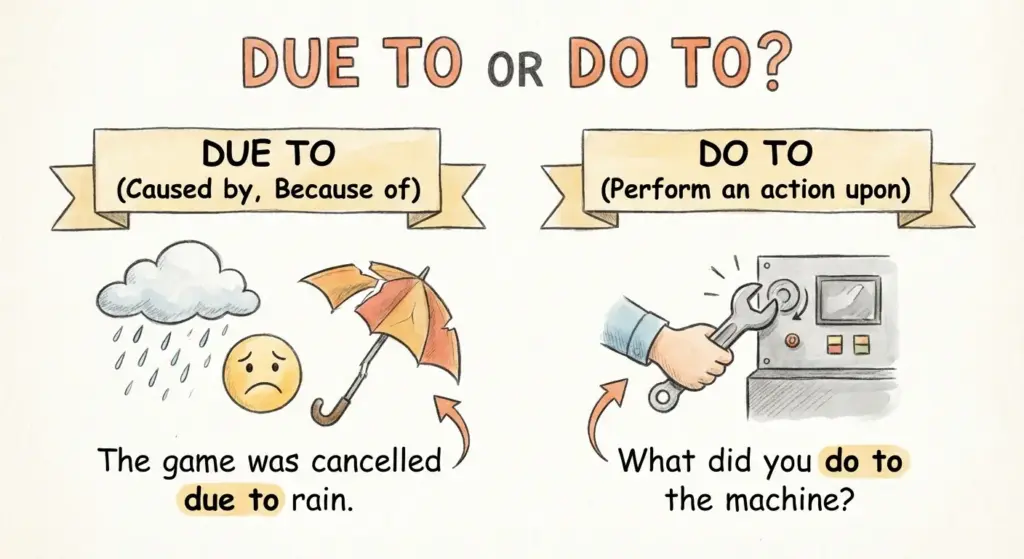
Due to is correct. Do to is incorrect. This is not a matter of preference or regional variation. “Due to” is a legitimate English phrase meaning “because of,” “owing to,” or “caused by.” The spelling “do to” is always wrong when trying to express this meaning.
✓ Due to the storm, the flight was canceled.
✗ Do to the storm, the flight was canceled.
The confusion arises because “due” and “do” are homophones—they sound identical when spoken aloud. This phonetic similarity leads many writers to mistakenly write “do to” when they mean “due to.”
Understanding “Due”: Multiple Functions
The word “due” serves three different grammatical functions in English, making it a versatile and important word to master. 1. Due as an Adjective (Most Common) As an adjective, “due” means “expected,” “scheduled,” “owed,” or “appropriate.”- The assignment is due on Friday. (expected/scheduled)
- The rent is due at the beginning of each month. (owed)
- She deserves the recognition due to her hard work. (appropriate/owed)
- The baby is due in December. (expected)
- Your payment is now past due. (owed)
- Members must pay their annual dues by March 1st.
- Union dues are deducted automatically from paychecks.
- The club charges monthly dues of $50.
- He hasn’t paid his dues to society yet.
- The ship sailed due north. (directly north)
- The trail heads due east from here. (exactly east)
- Turn due south at the intersection. (directly south)
Understanding “Do”: The Action Verb
“Do” is one of the most common and versatile verbs in English. It functions both as a main verb and as an auxiliary (helping) verb. Do as a Main Verb As a main verb, “do” means “to perform,” “to execute,” or “to complete an action.”- What should I do about this problem?
- She does yoga every morning.
- They did their homework before dinner.
- Can you do me a favor?
- He does excellent work.
- Do you understand the instructions? (question formation)
- I do not agree with that decision. (negative statement)
- She does want to attend the meeting. (emphatic statement)
- Did they finish the project on time? (past tense question)
Why the Confusion Exists
Several factors contribute to the widespread confusion between “due to” and “do to.” Homophones: Identical Pronunciation “Due” and “do” are pronounced identically in most English dialects: /duː/. When spoken, “due to” and “do to” sound exactly the same, making it impossible to distinguish them by ear alone. Lack of Visual Reinforcement Many people learn phrases primarily through listening rather than reading. Without seeing the correct written form, the distinction between these homophones never becomes clear. Phonetic Spelling Tendency Writers sometimes spell words as they sound rather than following standard spelling conventions. Since “do” is a more common, familiar word than “due,” some writers default to the more recognizable spelling. Informal Speech Patterns In casual conversation, pronunciation may be unclear or rushed, making it difficult to mentally connect the spoken phrase with its correct spelling.How to Use “Due To” Correctly
“Due to” functions as a compound preposition meaning “because of,” “caused by,” or “owing to.” It introduces the reason or cause for something. Meaning: Because of / Caused by Use “due to” when explaining why something happened or identifying the cause of a situation.- The delay was due to heavy traffic on the highway.
- Due to budget constraints, the project was postponed.
- His absence was due to illness.
- The game was canceled due to rain.
- Due to increased demand, prices have risen.
- Her success is due to years of hard work and dedication.
- The error was due to a software glitch.
- Population growth is due to improved healthcare.
- The victory was due to excellent teamwork.
- The cancellation was due to technical difficulties. (follows “was”)
- Due to unforeseen circumstances, the event is rescheduled. (sentence beginning)
- Her appointment is due to her expertise. (follows “is”)
The Exception: When “Do” and “To” Appear Together
While “do to” is never correct as a compound phrase meaning “because of,” the words “do” and “to” can legitimately appear next to each other in certain sentence constructions. Valid Constructions with “Do” + “To” These constructions involve “do” as a verb followed by “to” as either a preposition or part of an infinitive.- What did they do to him? (“to” is a preposition indicating recipient of action)
- Tell me what I can do to help. (“to” begins an infinitive phrase “to help”)
- What will the government do to address this issue? (“to” introduces purpose)
- She didn’t know what to do to fix the problem. (“to” is part of infinitive)
- What did you do to your hair? (preposition showing object of action)
Correct (verb + preposition): What did they do to the building?
Incorrect (wrong phrase): The closure was do to vandalism.
Correct (right phrase): The closure was due to vandalism.
Pronunciation Guide
Understanding pronunciation helps explain the confusion while also providing a way to remember the correct spelling. Due- Pronunciation: /djuː/ (sounds like “dew” or “jew”)
- Phonetic spelling: DYOO
- Rhymes with: cue, few, new, view
- Pronunciation (stressed): /duː/ (identical to “due”)
- Pronunciation (unstressed): /də/ (like “duh”)
- Phonetic spelling: DOO (when stressed)
- Rhymes with: too, who, zoo, blue
Common Mistakes to Avoid
Recognizing common error patterns helps prevent mistakes before they occur. Mistake 1: Using “Do To” for Causation- ✗ The meeting was postponed do to scheduling conflicts.
- ✓ The meeting was postponed due to scheduling conflicts.
- ✗ Do to the weather, school is closed.
- ✓ Due to the weather, school is closed.
- ✗ His promotion was do to excellent performance.
- ✓ His promotion was due to excellent performance.
- ✗ Sorry for the delay do to technical issues.
- ✓ Sorry for the delay due to technical issues.
Memory Tips and Tricks
These strategies help reinforce the correct usage and prevent future errors. Substitution Test Replace “due to” with “because of” or “caused by.” If the sentence still makes sense, “due to” is correct.
Original: The delay was due to traffic.
Test: The delay was because of traffic. ✓ (makes sense)
Conclusion: “Due to” is correct here.
Visual Association
Remember: “DUE” contains the word “UE” which can stand for “Underlying Event” or “Underpinning Explanation” — both relate to causation.
Word Family Connection
Connect “due” with related words: overdue, undue, due date. These all relate to time, expectation, or obligation — never to the action verb “do.”
Pronunciation Reminder
Though “due” and “do” sound alike, remember: “DUE rhymes with CLUE” — and the clue is that it explains WHY something happened.
Grammar Check
If explaining a cause or reason, the phrase must be “due to” (two words starting with different letters: D-U). “Do to” would have both words starting with D-O, which looks wrong visually.
Practical Examples by Category
Weather and Natural Events- ✓ The flight was diverted due to fog.
- ✓ Due to the storm, all schools are closed.
- ✓ The harvest failed due to drought.
- ✓ Due to earthquakes, many buildings were damaged.
- ✓ She was absent due to illness.
- ✓ Due to allergies, he avoids certain foods.
- ✓ The symptoms are due to stress.
- ✓ Due to the pandemic, masks are required.
- ✓ The project was delayed due to budget cuts.
- ✓ Due to restructuring, several positions were eliminated.
- ✓ Her promotion was due to outstanding performance.
- ✓ Due to high demand, supplies are limited.
- ✓ The exam was postponed due to technical difficulties.
- ✓ Due to plagiarism, the student received a failing grade.
- ✓ Class was canceled due to low enrollment.
- ✓ Due to his research, the professor received an award.
- ✓ The train is running late due to signal problems.
- ✓ Due to construction, the highway is closed.
- ✓ Ferry service was suspended due to high winds.
- ✓ Due to mechanical issues, the bus broke down.
Due To vs. Because Of: A Quick Note
While “due to” and “because of” are often used interchangeably in modern English, traditional grammar makes a distinction. Traditional Rule (Formal Writing) “Due to” should modify nouns (following a linking verb like “is” or “was”). “Because of” should modify verbs.- Due to: The cancellation was due to rain. (modifies noun “cancellation”)
- Because of: The game was canceled because of rain. (modifies verb “was canceled”)
Quick Reference Guide
Use “Due To” When:- Explaining why something happened or exists
- Identifying the cause of a situation or event
- Expressing “because of” or “caused by”
- Following forms of “to be” (is, was, are, were)
- Beginning a sentence to introduce a reason
- Expressing causation (always incorrect)
- Replacing “because of” (always incorrect)
- Explaining reasons or causes (always incorrect)
- Any situation where “due to” is meant (always incorrect)
- “Do to” is not a real phrase meaning “because of”
- “Due to” is always the correct spelling for expressing causation
- When in doubt, substitute “because of” — if it works, use “due to”
- Proofread carefully, as spell-checkers may not catch this error