

Key takeaways:
- Since indicates a starting point in the past with the present perfect (I’ve worked since 2010)
- For indicates a duration or period of time (I’ve worked for 14 years)
- Since is used with specific dates/moments; for with durations (days, hours, months)
Two words, two different roles but often confused. Since and for are both related to time in English, but they function in opposite ways. Understanding this difference changes everything in constructing correct sentences. Let’s explore together how to use each one in a professional or personal context.
Since: a precise starting point
Since is used to indicate the exact moment when something began. It’s a reference point in time: a date, a time, an event. You’ll always use it with the present perfect in English to describe an action that started in the past and continues now.
In a professional context, for example: “I’ve worked at this company since 2015” means you started in 2015 and you still work there. The starting point is clear and precise. Similarly, “The project has been on hold since March” indicates exactly when the project stopped.
| Structure | Examples |
|---|---|
| Since + date | Since 2020, since January, since last Tuesday |
| Since + time | Since 9am, since lunchtime, since this morning |
| Since + event | Since she arrived, since the meeting started, since we met |
For: an expressed duration
For measures the length of time, the duration. Three hours, two weeks, several years: these are durations. You’ll use for to say how long something has lasted or is still lasting, without mentioning the exact starting point.
At work, “I’ve been in this role for three years” means you’ve held this position for three years, without specifying exactly when. “The team has been collaborating for two months” indicates a duration of two months, whatever the precise start date.
| Durations with for | Examples |
|---|---|
| Short durations | For 10 minutes, for 2 hours, for half an hour |
| Long durations | For three months, for two years, for a decade |
| Indefinite durations | For a long time, for ages, for quite a while |
Direct comparison: since vs for
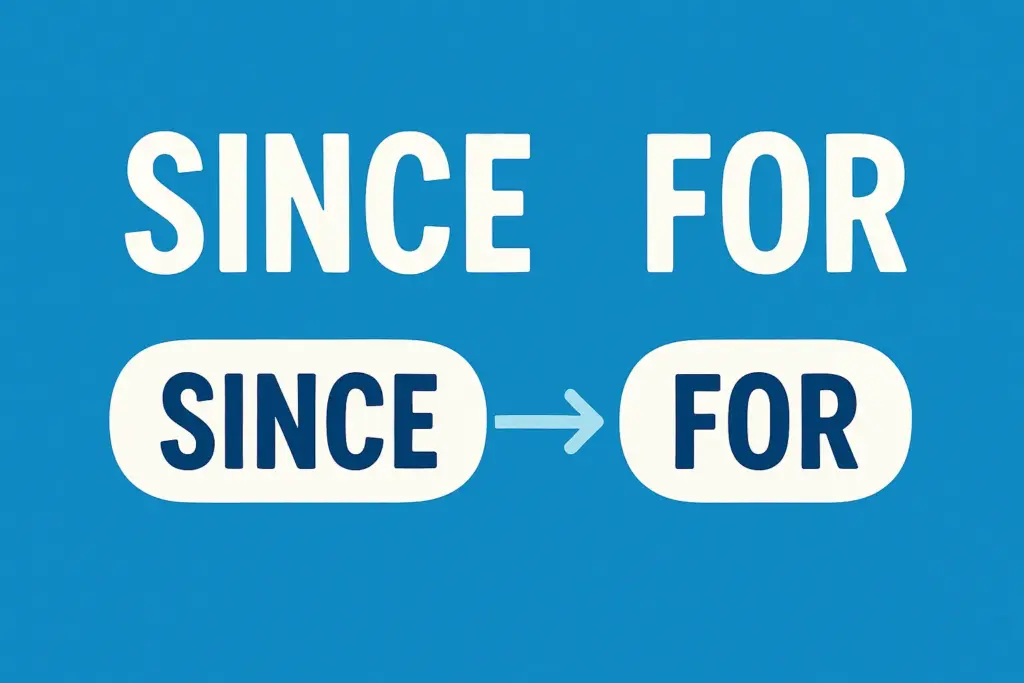
To memorize the difference well, look at these two sentences: “I’ve studied English since 2010” (starting point = 2010) and “I’ve studied English for 14 years” (duration = 14 years). The first situates you in time, the second measures the length. They can mean exactly the same thing, but the approach is different.
| With Since (starting point) | With For (duration) |
|---|---|
| I’ve been married since 1998 | I’ve been married for 26 years |
| She’s lived in Paris since she was 21 | She’s lived in Paris for most of her life |
| They haven’t spoken since last December | They haven’t spoken for nearly a year |
| The client has been waiting since 2pm | The client has been waiting for two hours |
Professional contexts: real-world usage
In a meeting: “We’ve been developing this feature since January” shows when the work started. Your manager immediately understands the timing. By contrast, “We’ve been developing this feature for five months” indicates only the duration of investment without date context.
In a job application email: “I’ve worked in marketing since 2015” positions your experience in time. “I’ve worked in marketing for eight years” measures your competence by duration. Both inform the recruiter differently. Good mastery of English articles will also be useful for polishing your entire written communication.
Mistakes to absolutely avoid
- Don’t say “I’m waiting since two hours” but “I’ve been waiting for two hours” (duration = for, not since)
- Don’t use “for” with a starting point: not “I’ve worked for 2020” but “I’ve worked since 2020”
- Don’t confuse with “ago”: not “It’s a long time ago since…” but rather “It’s been a long time since…” or simply “It was a long time ago”
Another common confusion: using since with the simple past instead of the present perfect. Saying “I work here since 2015” is incorrect. It’s “I’ve worked here since 2015” or “I’ve been working here since 2015” that you need to use.
Since with clauses and -ing forms
Since can also introduce a clause: “I haven’t seen him since he moved to London.” Or in -ing form: “Since leaving school, he’s had three jobs.” These constructions are common in formal or literary contexts. The structure remains the same: since indicates the starting point of an action or situation that extends to the present.
Note also that “ever since” reinforces the idea: “I’ve hated public speaking ever since that presentation went wrong.” It’s a more emphatic equivalent of since alone.
Interactive exercise: test your understanding
Choose the correct answer for each question. Corrections appear immediately.